
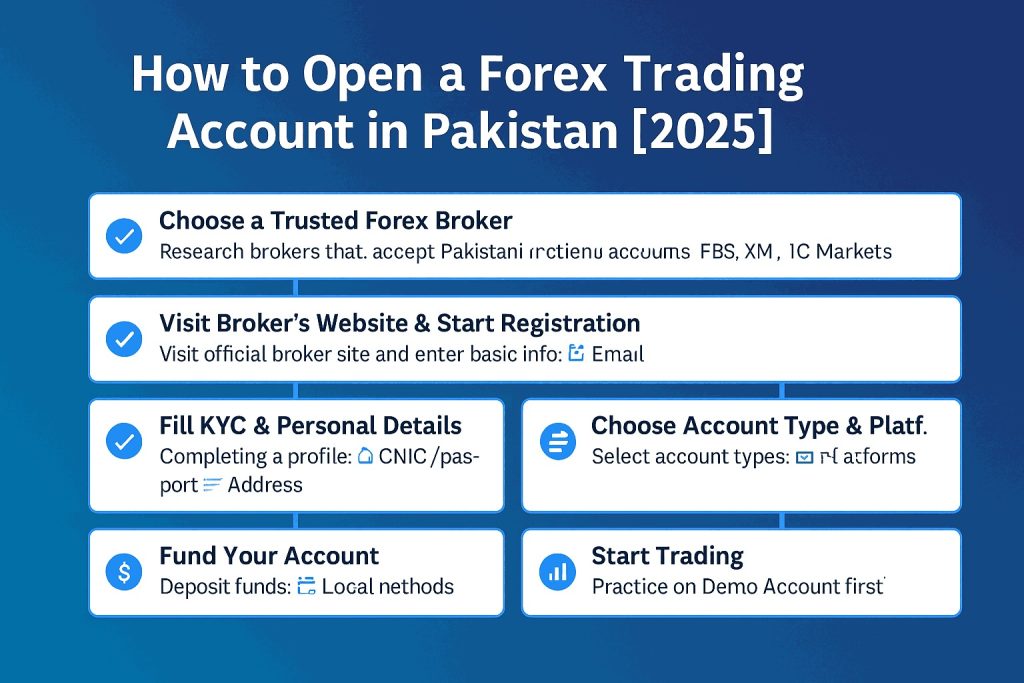
Short Answer
Learning how to open a forex trading account in Pakistan is simple: choose a regulated broker, register with your name, email and phone number, and verify your identity with a Smart CNIC or passport plus a recent utility bill or bank statement. Then pick an account type, fund it, and practise on a demo account before you place a real trade. The whole process usually takes a few hours to a day, and most of it is done from your phone.
One warning comes first: no broker is licensed in Pakistan to offer retail offshore forex trading, and the State Bank of Pakistan warned residents against offshore forex platforms in May 2022. This guide explains the honest picture, including the regulated PMEX route.
What Is a Forex Trading Account?
A forex trading account is an online account with a broker that lets you buy and sell currencies in the global market. It is your gateway to trading pairs such as EUR/USD, GBP/USD and USD/JPY, and usually gold, oil and stock indices as well.
Most retail traders trade through contracts for difference (CFDs). A CFD lets you trade on a price movement without owning the currency itself, and you can trade rising and falling markets. It uses leverage, which magnifies gains and losses alike.
Your account connects to a trading platform, most often MetaTrader 4 (MT4) or MetaTrader 5 (MT5). You log in with the trading ID and password the broker gives you after registration. Most international brokers do not offer USD/PKR as a tradable pair, so Pakistani traders usually focus on major international pairs. Before you fund anything, check the live dollar rate so you know what your rupees are worth in dollars.
Is Forex Trading Allowed in Pakistan?
This is the question every beginner asks, and most guides answer it badly. Here is the honest picture.
Forex trading in Pakistan sits in a grey area. The State Bank of Pakistan (SBP) controls foreign exchange under the Foreign Exchange Regulation Act, 1947. In May 2022, SBP issued EPD Circular No. 08, warning Pakistani residents against buying the products of offshore forex trading platforms, and that sending money to such platforms is not a permitted purpose under foreign exchange rules.
The Securities and Exchange Commission of Pakistan (SECP) has never issued a licence for retail offshore forex or CFD trading. There is no licence category for it, so no broker holds one. The only fully regulated route for currency trading in Pakistan is the Pakistan Mercantile Exchange (PMEX), an SECP-licensed futures exchange. Through a licensed PMEX broker you can trade currency-pair futures, fund in rupees through a Pakistani bank, and take a dispute to a Pakistani regulator.
At the same time, a very large number of Pakistanis trade with internationally regulated offshore brokers. If you take that route, understand the trade-off: the broker may be well regulated abroad, but you have no protection in Pakistan, and funding it carries exposure under foreign exchange rules. Trading profits are taxable income in Pakistan and should be declared to the Federal Board of Revenue (FBR).
What You Need Before You Start
Before you open forex account in Pakistan, get your documents ready. It takes ten minutes, and it is the difference between verification in a few hours and a week of back-and-forth emails.
- Identity proof: a valid Smart CNIC is the standard document. A passport works too, and some brokers accept a driving licence.
- Address proof: a utility bill (electricity or gas) or a bank statement, dated within the last three months. The name and address on it must match your CNIC.
- Contact details: an active email address and a Pakistani mobile number you can receive an SMS code on.
- A funding method in your own name: a JazzCash or EasyPaisa wallet, or a local bank account. The name on it must match the name on your trading account.
Take clear photos of your CNIC, front and back, in good light with all four corners visible. Blurry photos are the most common reason verification fails.
How to Open Forex Trading Account in Pakistan — Step by Step
Follow these steps in order. Do not deposit money before your account is verified.
Step 1: Choose a Regulated Broker
This is the decision that matters most. A broker regulated by a strong authority, such as the UK’s FCA, Australia’s ASIC or Cyprus’s CySEC, is answerable to a real regulator. Check the licence number on the regulator’s own website, not just on the broker’s page. Then confirm the broker accepts clients from Pakistan and offers funding methods that work here. Our guide to the best forex broker in Pakistan compares the brokers Pakistani traders actually use.
Step 2: Register on the Broker’s Website
Go to the broker’s official website and click “Register” or “Open Account”. Fill in your real name exactly as it appears on your CNIC, your email address, your country (Pakistan) and your phone number. Set a strong, unique password. Use an email address you check daily, because the broker sends your login details there.
Step 3: Complete Forex Account Verification
Forex account verification is the know-your-customer (KYC) check every regulated broker must run. Upload a clear photo of the front and back of your CNIC, then upload your address proof. Some brokers also ask for a selfie holding your CNIC. Approval usually takes a few hours to a day. Verify on day one, not at your first withdrawal.
Step 4: Choose Your Account Type
Pick the account type that fits your budget and experience. Beginners usually start with a Standard or Cent account — the table in the next section explains the differences. If you need an interest-free account, ask for a swap-free Islamic account now, because switching later is harder.
Step 5: Download the Trading Platform
Download MetaTrader 4 or MetaTrader 5 on your phone or computer. A good forex trading platform in Pakistan needs to work well on mobile, because most Pakistani traders trade from their phones. Log in with the trading ID and password the broker sent you, and select your broker’s server from the list. Most brokers also offer their own forex trading app in Pakistan through the Play Store or App Store, with the same login.
Step 6: Open a Demo Account and Practise
Before you deposit anything, open a demo account. It comes with virtual money and works exactly like a live account. Place a few trades, learn where the buy and sell buttons are, and test your approach for at least a week.
Step 7: Deposit Funds
Once verified and practised on demo, deposit from the broker’s cashier. Many brokers allow deposits from as little as $5 to $10, but $50 to $100 gives you room to manage risk properly. Check the withdrawal options before you deposit: the exit route is often narrower than the deposit route.
Step 8: Place Your First Trade
Start small. Pick one major pair, such as EUR/USD, risk only a small part of your account on a single trade, and always set a stop loss before you enter. The forex market runs 24 hours a day, five days a week, and the busiest hours for Pakistani traders fall in the afternoon and evening, when the London and New York sessions overlap.
Choose the Right Account Type
Most brokers offer the same four account types. The right one depends on how much you can deposit and how you plan to trade.
| Account Type | Best For | Key Feature |
|---|---|---|
| Standard | Beginners | Low minimum deposit, no commission |
| Cent | Very small deposits | Trades in cents, lowest risk per trade |
| ECN / Raw Spread | Experienced traders | Near-zero spreads, small fixed commission |
| Islamic (Swap-Free) | Muslim traders | No overnight interest charges |
A Cent account is the safest way to learn with real money, because a $10 deposit shows as 1,000 cents and each trade risks very little. An ECN account only makes sense once you trade regularly in larger sizes. Our Exness review and OctaFX review list the exact account types, minimum deposits and spreads each broker offers.
Practise First: Open a Demo Account
A demo account is free, takes two minutes to open, and is the single best tool a beginner has. Use it to learn the platform, test a strategy, and find out whether you can follow your own rules when a trade goes against you.
Treat demo money seriously: trade the same position sizes you would use with real money, and set your demo balance to match the amount you actually plan to deposit.
How to Fund Your Account from Pakistan
Funding is where most Pakistani beginners get stuck. Here is what actually works.
- JazzCash and EasyPaisa: the two wallets most Pakistani traders use. Brokers usually reach them through a local payment partner, so the option appears in the cashier as a local payment method. The name on the wallet must match the name on your trading account.
- Local bank transfer: the most widely supported route. You transfer rupees from your Pakistani bank account, and the broker’s payment partner converts them to dollars. It usually takes one to three working days.
- Bank cards: Pakistani debit and credit cards usually fail on offshore broker cashiers. Banks were instructed to block payments to offshore forex platforms, so plan around the card route rather than being surprised by it.
- Crypto: some brokers accept crypto deposits, which bypass the banking channel entirely. The regulatory position of crypto in Pakistan has changed over time, so check the current position before relying on it.
Two rules protect your money. First, fund only from an account in your own name. A deposit from a relative’s or an agent’s wallet will usually clear on the way in and block your withdrawal on the way out, because the broker cannot return money to a different name. Second, every deposit crosses a rupee-to-dollar conversion at the payment partner’s rate, which is worse than the official rate. You pay that conversion twice on a round trip, even when the cashier’s fee line reads zero.
Swap-Free Islamic Accounts
Many Pakistani traders want an account that follows Islamic principles, and the main issue is riba, or interest. In a standard account, a position held overnight is charged or paid a small interest adjustment called a swap. A swap-free account, also called an Islamic account, holds positions overnight without that interest charge.
Most major brokers offer swap-free accounts to Pakistani clients. Ask for it when you open the account, because switching an existing account to swap-free is not always possible. Some brokers apply an administration fee instead of a swap on positions held for a long time, so read the terms before you choose.
What to Do If Verification Fails
Verification fails more often than brokers admit. Work through these fixes in order.
- Blurry or cropped photos: retake the CNIC photo in daylight, on a plain background, with all four corners visible. Do not use a flash, which washes out the text.
- Name mismatch: the name on your trading account must match your CNIC exactly, including spelling. If you registered with a nickname or a shortened name, ask support to correct it before you re-upload documents.
- Old address proof: the utility bill or bank statement must be dated within the last three months. An old bill is the most common rejection after a blurry photo.
- Address mismatch: the address on your proof must match the address you entered at registration and the address on your CNIC. If you have moved, update your profile first, then upload a bill for the new address.
- Wrong document type: some brokers do not accept a driving licence as address proof, and some do not accept it as identity proof either. A Smart CNIC and a utility bill are the safest combination.
If you have fixed the problem and still get rejected, contact live support and ask for the exact reason. Do not open a second account with different details to get around a rejection: duplicate accounts are a common reason for a permanent ban.
Common Mistakes Beginners Should Avoid
- Trading without a plan: entering the market on a tip or a rumour is gambling, not trading. Decide your entry, stop loss and target before you open a trade.
- Using very high leverage: leverage can wipe out a small account in minutes. Start with the lowest leverage your broker offers.
- Ignoring stop losses: a stop loss is the one tool that limits how much a bad trade can cost you. Never open a trade without one.
- Depositing money you cannot afford to lose: most beginners lose their first deposit. Never trade with rent money, borrowed money or savings you need.
- Trusting “guaranteed profit” offers: no broker, signal seller or account manager can guarantee profits. Anyone who promises them is running a scam.
- Skipping the demo stage: a week on demo costs nothing; a week of live trading without practice can cost your whole deposit.
